By Scott Mammoser, Team FSO writer
Photos courtesy Scott Mammoser
VERONA, Italy – The figure skating competition of the Milano Cortina Olympics was anything but conventional. It was fitting that the athletes would unite one final time for a closing ceremony on Sunday that was unlike any in modern times.
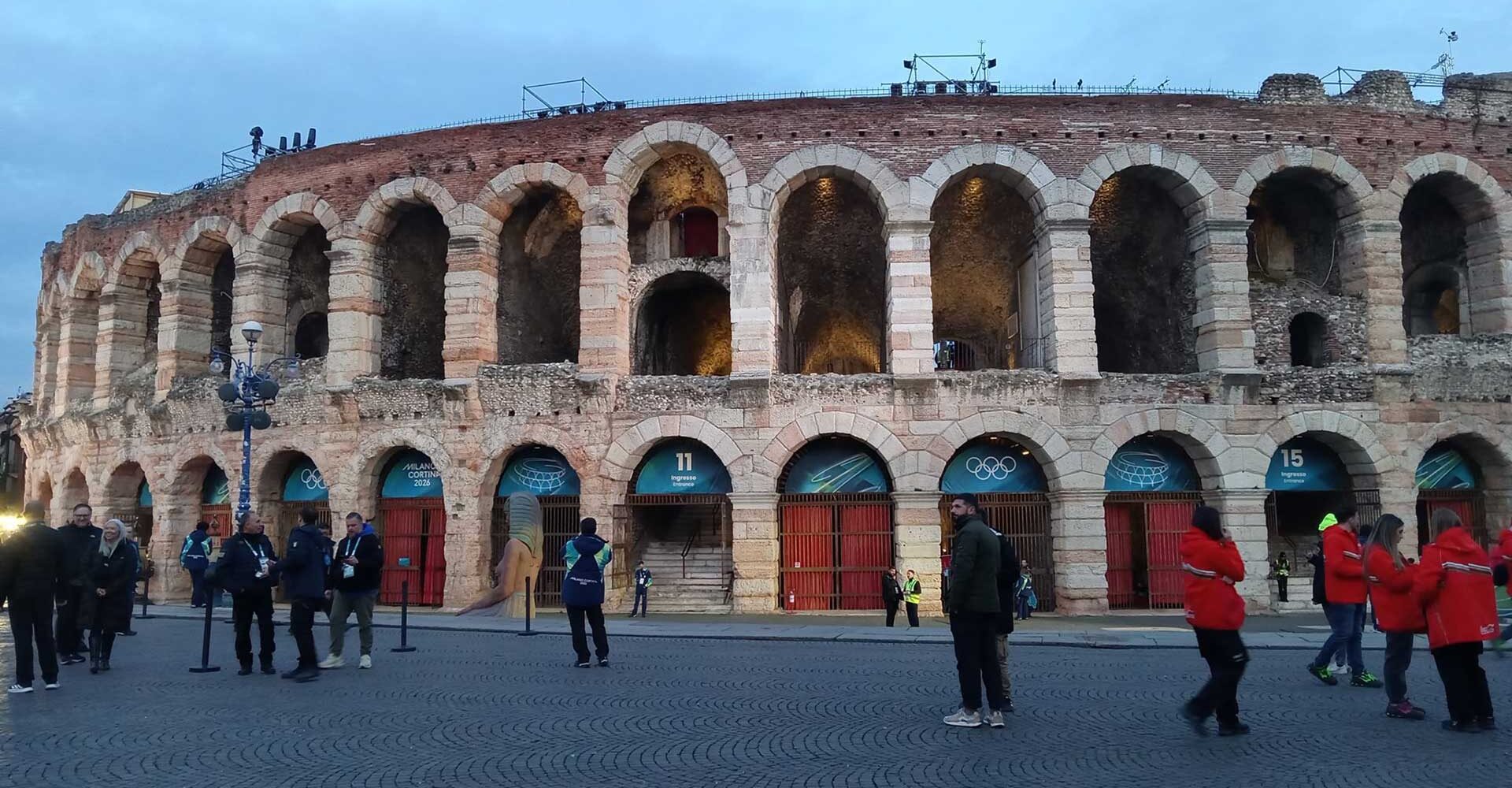
The gathering occurred at the Verona Arena, a Roman amphitheater that dates to 30 A.D. It puts quite a lot into perspective, as the century-old Stadio San Siro that hosted the opening ceremony seemed so historic at the time.
Following a performance from the opera “La Traviata,” athletes carried their national flags into the arena. Ice dancer Evan Bates was chosen to represent the U.S., along with gold medal-winning hockey player Hilary Knight. Competing in his fifth Olympics, Bates won the gold medal in the team event, along with silver in ice dance event with his partner and wife Madison Chock. Previously, Tim Wood was the only figure skater to carry a U.S. flag in the closing ceremony, which he did after winning the silver medal at Grenoble in 1968. Scott Hamilton presented it at the opening of Lake Placid 1980.
Men’s gold medalist Mikhail Shaidorov of Kazakhstan carried his national flag, as well as Japanese silver medalist Kaori Sakamoto. Other figure skaters carrying flags included: Pairs team Maria Pavlova and Alexei Sviatchenko of Hungary, Iida Karhunen of Finland, Niina Petrokina of Estonia, Luka Berulava of Georgia, Meda Variakojyte of Lithuania, Donovan Carrillo of Mexico, and Julia Sauter of Romania.
As this was the first widespread Olympics, many nations did not designate any flagbearers. Volunteers carried those flags, unlike in the awkward moments of the opening ceremony.
After the parade of flags, the remainder of athletes appeared, and the pairs skaters were the easiest to spot in the crowd, as the men were carrying their partners on their shoulders or lifting them above their heads. Gold medalists Riku Miura and Ryuichi Kihara of Japan were very recognizable.
NBC reported that 12,000 people were in attendance. While the athletes were situated in the lower bowl of the arena, it seemed there was not much room for paying customers among the credentialed guests. However, a young woman from Michigan said she bought a ticket for $200 US, just hours before the event. Meanwhile, a young man from Japan mentioned to Figure Skaters Online that he bought his ticket much in advance and it cost $1,000 US.
Other key moments during the ceremony included the address from new International Olympic Committee (IOC) president Kirsty Coventry, the handover of the Olympic flag to the 2030 hosts- the French Alps, and the extinguishing of the flame. In this case, the flame was carried in a small lantern by Arianna Fontana, the Italian short track speed skater who now has 14 career medals.
The volunteers were applauded for their contributions several times. In the leadup to the show, Mario Gargiulo was brought on stage to speak. The 89-year-old served as a volunteer at both the 1956 Cortina d’Ampezzo Games and the present ones.
As the electronic dance music faded from the arena and the athletes dispersed, the 25th edition of the Olympic Winter Games became part of history. New faces with original stories will emerge over the next four years, and we’ll be waiting for the next chapter in France.
The cities of Milan and Cortina aren’t done with hosting duties just yet. They will welcome the 14th edition of the Winter Paralympic Games, March 6-15, 2026.