By Scott Mammoser, Team FSO staff writer
Photos: Getty Images and Figure Skaters Online file photos
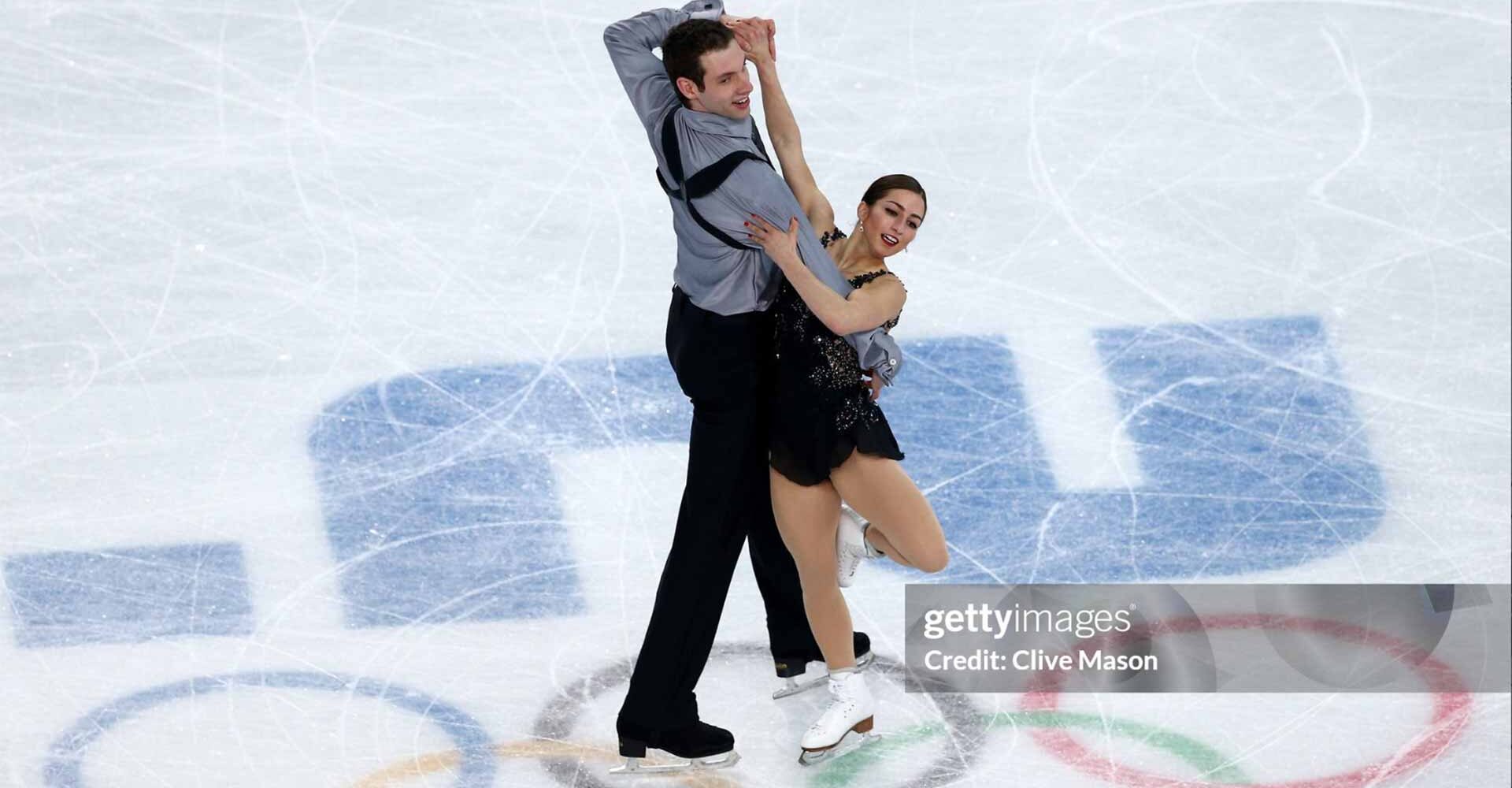
Team FSO staff writer Scott Mammoser caught up with Marissa Castelli and Simon Shnapir, the 2013 and 2014 U.S. Champions and 2014 Olympic Team Bronze medalists. This is Scott’s fifth article in his 2025 series catching up with former World and Olympic competitors.
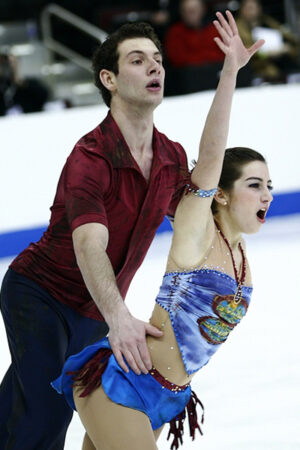 One the most-successful American pairs teams of the 2010s, Marissa Castelli and Simon Shnapir are building off their own regard to shape the future of the Skating Club of Boston.
“We know the ups and downs,” said Castelli, who is now married with a 13-month old son named Theodore. “We’ve seen a lot. It’s a great dynamic we have where we trust each other so much. We started off green together and grew to be one of the best pairs teams in the country, and bringing that experience to our younger teams, it’s great to see their enthusiasm.”
Each with a birthday on August 20, Castelli, now 35, and Shnapir, now 38, seemed destined for partnership – although they admit there are no special birthday celebrations. After teaming up in April 2006, the two, who trained at the Skating Club of Boston, made their international debut in the 2007-2008 season and then won the bronze medal at the 2009 World Junior Championships in Sofia, Bulgaria. Things really came together during the 2012-13 season, with bronze medals at both the NHK Trophy and Four Continents Championships, and then winning their first U.S. title. The following season, with Boston hosting the 2014 Nationals and with spots on the line for the Sochi Olympic team, all eyes focused on the Massachusetts residents.
“It was terrifying to hear that (Nationals) was in Boston,” said Castelli, who is originally from Providence, R.I. “It’s either going to be the best moment of our lives or the worst. Our coaches did a great job setting us up right up to the moment. That was a great moment for us.” 
“Leading up to that championship, we knew it was going to be in our hometown, and we started to see the signs of that championship, several months leading up to it,” added Shnapir, who was born in Moscow, but immigrated to the U.S. with his family as toddler, settling in the Boston area. “You are driving to the rink, and you see your face plastered on a billboard. It’s cool, but it’s also absolutely nerve-wracking. Skating in front of your home crowd and in front of your friends, family and training mates is arguably more difficult than just competing in a random country. At that point, we were professionals, we already had a national title under our belt, and we competed at a world championship. We did a really great job of feeding off that hometown crowd that was behind us the whole time. We really felt that support. To do what we did, that year, at home, in an Olympic year – those days will be hard to forget.”
Castelli and Shnapir won their second-consecutive U.S. title in Boston and were subsequently named to the Olympic team. The figure skating competition at the Sochi Olympics introduced the team event. Castelli and Shnapir were selected to compete over U.S. teammates Felicia Zhang and Nathan Bartholomay, the 2014 U.S. silver medalists.
“It was kind of unreal,” Castelli said. “We went in knowing we would skate four programs, but we didn’t know a medal was at stake until after the short program.”
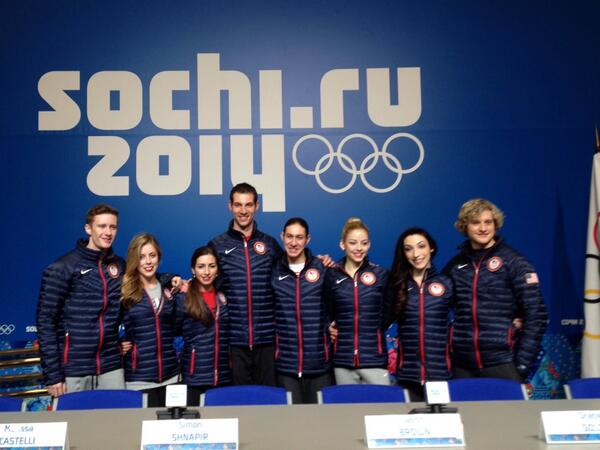 Following the advice of team captain Charlie White, they elected to rest rather than march in the opening ceremony and watch legendary pairs skater Irina Rodnina light the cauldron. Two days later, Team USA would capture the bronze medal behind Russia and Canada. Then, Castelli and Shnapir had to turn around and focus on their own event. Skating to “Skyfall” by Thomas Newman in the free skate, the team concluded in ninth place of the pairs competition.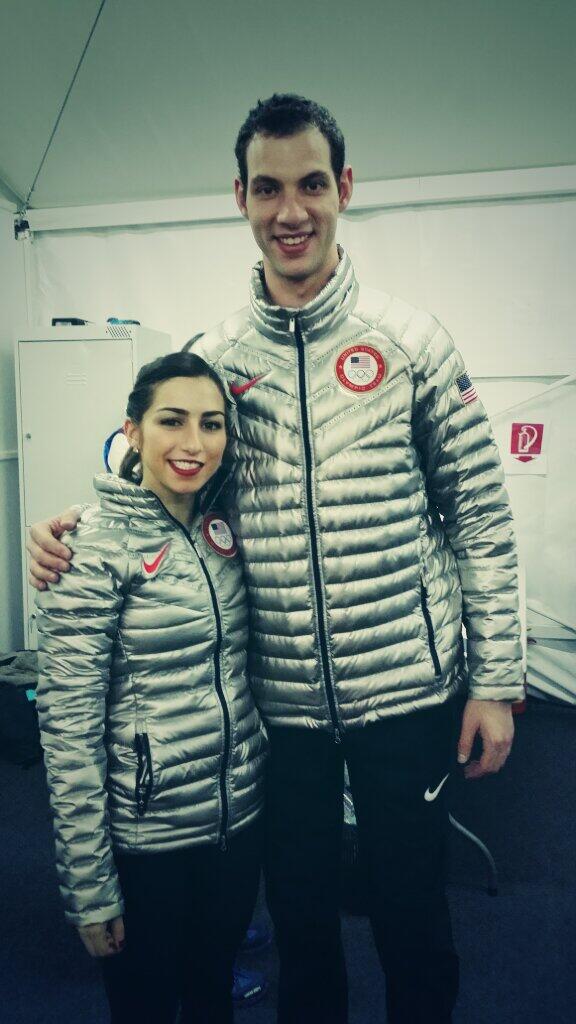
The following month, Castelli and Shnapir headed to Saitama, Japan, for the World Championships. An 11th place finish bettered their 13th place result from the 2013 Worlds in London, Ontario.
“London was insane because it was the year before the Olympics,” Castelli said of her Worlds experiences. “The pairs event was extremely strong that year. I don’t want to say it (2014 Worlds) was a blur, but after the Olympics, everything is a bit of a blur. We came home and trained, and showed up in Japan and did two more programs and right after that, we went to the White House and Stars On Ice. I don’t remember Japan as much as I remember London.”
While Sochi might have overshadowed those Saitama Worlds, Shnapir made it clear that Japan is a favorite destination for them.
“Japan for us is like a second home,” he said. “That was our sixth trip to Japan. We love to travel there, and we competed in a host of different competitions. We really enjoyed the crowd. Their support of figure skating is second to none.”
In May 2014, Castelli and Shnapir announced the end of their partnership. Later that spring, Shnapir briefly partnered with DeeDee Leng before retiring the following season. Meanwhile, Castelli won two more U.S. medals during her four-year partnership with world bronze medalist Mervin Tran.
Now, that her competitive career is over, she is once again together with Shnapir with the ambition of starting a pairs school. Currently, they train four teams.
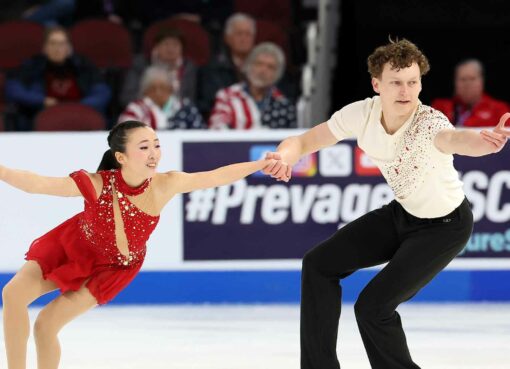
“We work with both singles and pairs,” Shnapir said. “Marissa and I both work with the Hayden Synchronized Skating teams, all of the way up to the Haydenettes senior team. We help them with a lot of pairs elements and pairs specialty tricks. Our primary focus is with our business. We have a juvenile, two intermediates, and a junior team that’s actually doing quite well this season (Sofia Jarmoc and Luke Witkowski). We are hoping for some big results in the coming years with that team. They have a lot of potential and we are working really hard to get them to an elite level.”
The youngest of Castelli and Shnapir’s teams are ages 12 and 14, which is slightly older than they both were when they began pairs skating.
“Because they are so young and at such an early stage,” Shnapir said, “it’s a good reminder of where we started from and how important it is to keep things light and fun. They need to be challenged and learn adversity, but at the end of the day, they have to have fun. If you are not having fun, why are you doing this? You get to a certain level, and it’s almost a job, at that point you are a professional. But at this early stage, we want them to really enjoy what they do and have fun with it.”
Shnapir still coaches ice dancing sporadically, but not as much, since he and Castelli are so focused on pairs. The number one goal is to have a thriving pairs team competing.
“It was nice while I was doing it,” he said of ice dance. “But I personally feel a lot more at home with the pairs skaters – within this community.”
If Jarmoc and Witkowski’s bronze medal at the Junior Grand Prix of Bangkok this season is any indicator, Castelli and Shnapir’s coaching is headed in the right direction.
“We’re both passionate and both driven,” he said. “We can be a little stubborn at times and a little fiery. We both really wanted it and would do whatever it took to get there.”
—
Editor’s Note: Learn more about Castelli and Shnapir’s junior pairs team, Sofia Jarmoc and Luke Witkowski in our new featured article on the team. It comes out Nov. 14.