By Gina Capellazzi, Team FSO website administrator
Photos by Robin Ritoss
TALLINN, ESTONIA — New champions were crowned at the ISU Junior World Championships March 4-7, 2026 in Tallinn, Estonia.
Women
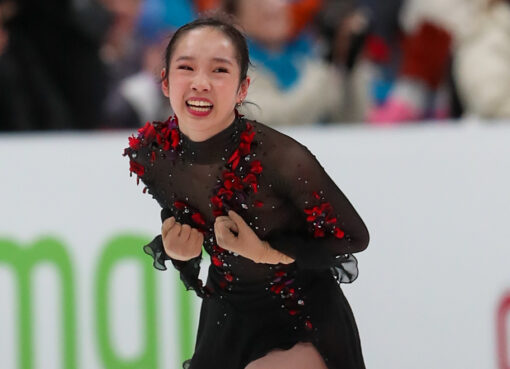
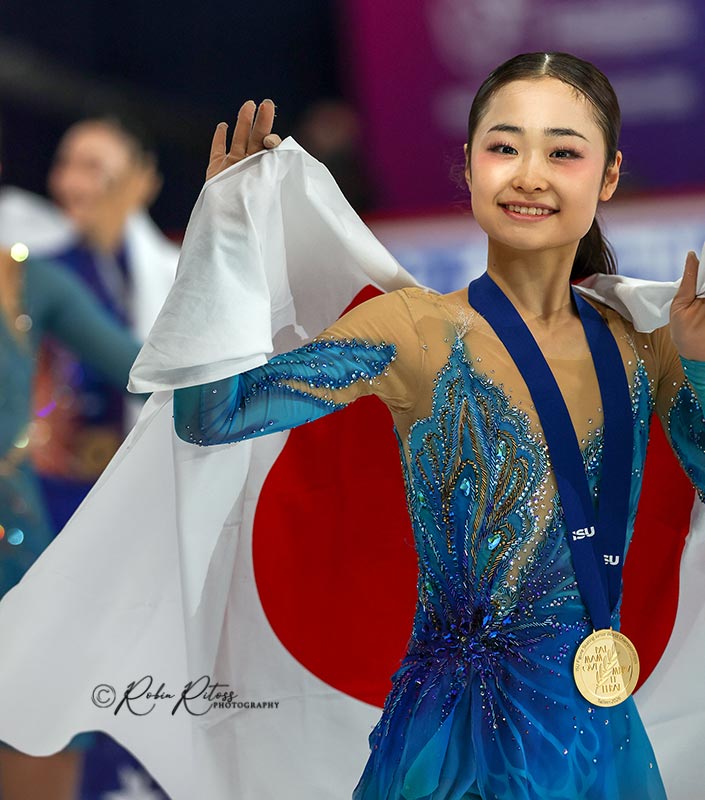 Despite feeling sick and staying in bed the day before the free skate, Japan’s Mao Shimada made history by winning her fourth consecutive World Junior title. No one has won four consecutive World junior titles before.
Shimada opened her “Miracle” free skate with a triple Axel and then completed six more clean triples. Her triple flip-double Axel-double Axel sequence was slightly under-rotated, plus her flying change foot combination spin only earned a level two. The Japanese Junior Champion earned a free skate score of 137.01 and ranked second in the free skate, but secured the gold with an overall score of 208.91.
Shimada revealed that she has been sick and considered withdrawing. She told the media that she stayed in bed the day before the free skate. During the women’s free skate, commentators Ted Barton and Mark Hanretty mentioned that Shimada had a difficult morning practice and wasn’t able to land any of her jumps. They also noted that she didn’t even attempt a triple Axel in practice either. However, despite the difficult practice, Shimada said she felt better than she had the day before and decided to still compete.
“My goal today was to just finish, not being nervous or anything, just to finish, and I was exhausted,” Shimada said. “However I was able to finish my performance and I think the fact that I never gave up led to this result of four consecutive wins.”
Now 17-years-old, Shimada will move up to the senior level next season.
Shimada wasn’t the only one making history. Australia’s Hana Bath claimed the silver medal, the first medal for Australia in single skating at the ISU World Junior Championships.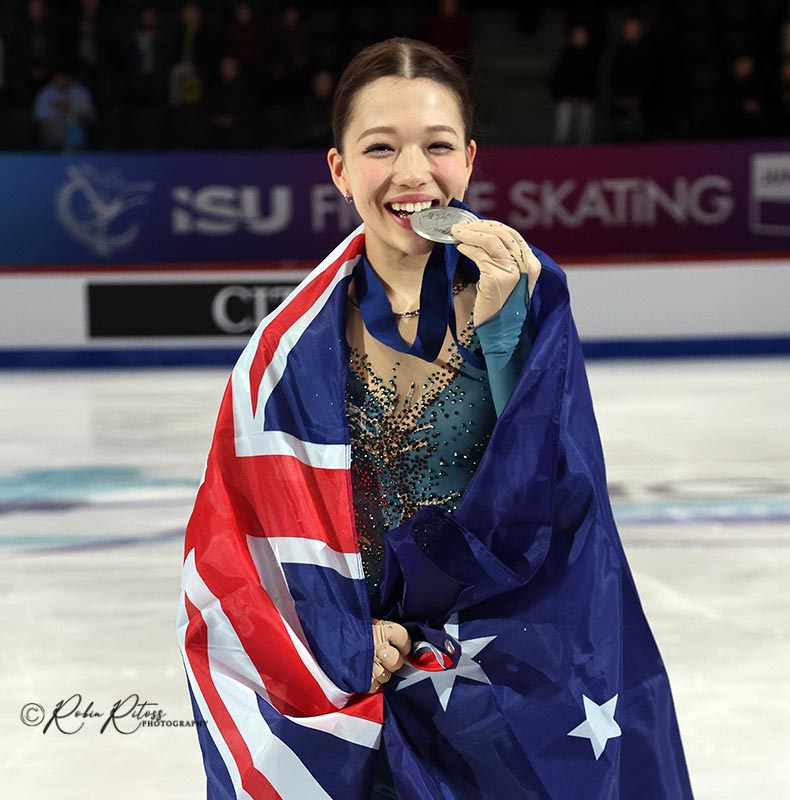
In her “Fountain of Eternity” and “Lullaby for Sadness free skate,” Bath opened the program with a triple Axel-triple toe combination, but over-rotated her solo triple Axel attempt. She did complete five more triple jumps, including a triple Lutz-double Axel-double Axel sequence late in the program. She earned a personal best free skate score of 138.44 and moved up from third after the short program to claim the silver medal with an overall score of 205.39.
“I’m really proud to represent Australia and I’m really happy that I could win this for our country,” Bath said. “I could skate my best today. I wanted to really enjoy this Junior World Championships and I’ve been able to do that last year as well as this year.
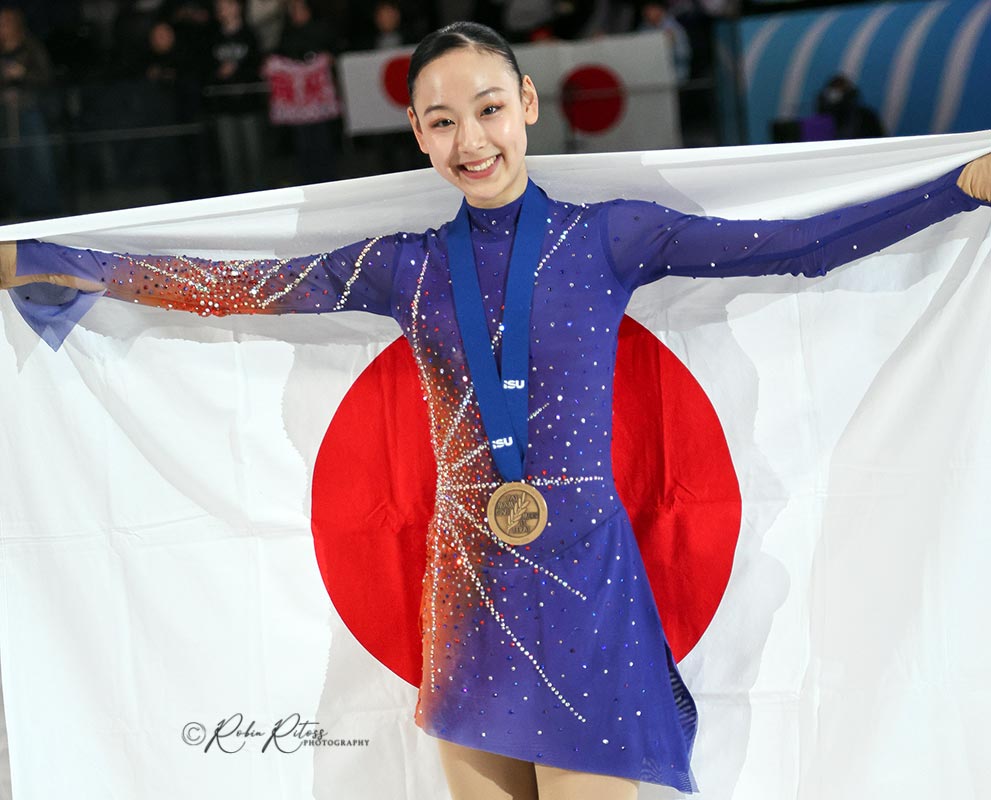 Japan’s Mayuko Oka of Japan claimed the bronze medal. Like Shimada and Bath, Oka attempted a triple Axel in her free skate, which is to “Some Bright Morning”, “The Flood Is Following Me” and “Other Song” by Caroline Shaw. However, she fell on the jump, but did manage to land six clean triple jumps, including a triple Lutz-triple toe combination. She earned a free skate score of 127.40, which was fourth in the segment. She dropped from second after the short program to third overall with 197.17 points.
“I had some mistakes on my jumps but I was able to enjoy my performance until the end, and I was able to keep myself calm and focused,” Oka said.
This was Oka’s first Junior World Championships. Since they are both 16-years-old and won’t be 17 by July 1, Bath and Oka are not eligible to compete in senior international events next season, so they will remain on the junior circuit for another season.
Israel’s Sofia Shifrin, who was fourth after the short program, nailed seven clean triple jumps in her “Schindler’s List” free skate to finish third in the segment with a score of 128.42. She finished fourth overall with a score of 193.80. She was 17th at the 2025 Junior World Championships.
China’s Yihan Wang improved on her 12th place finish at last year’s World Championships and placed fifth. For the second year in a row, Georgia’s Inga Gurgenidze finished sixth.
Mei Okada, who won the bronze at the Junior Grand Prix Final, had a rough short program and was in 24th place. She had the fifth best free skate to jump up 14 placements to finish 10th overall.
Team USA’s Angela Shao and Sophie Joline von Felten finished 9th and 12th respectively.
A total of 50 skaters competed in the women’s event, with only 24 qualifying for the free skate.
Men
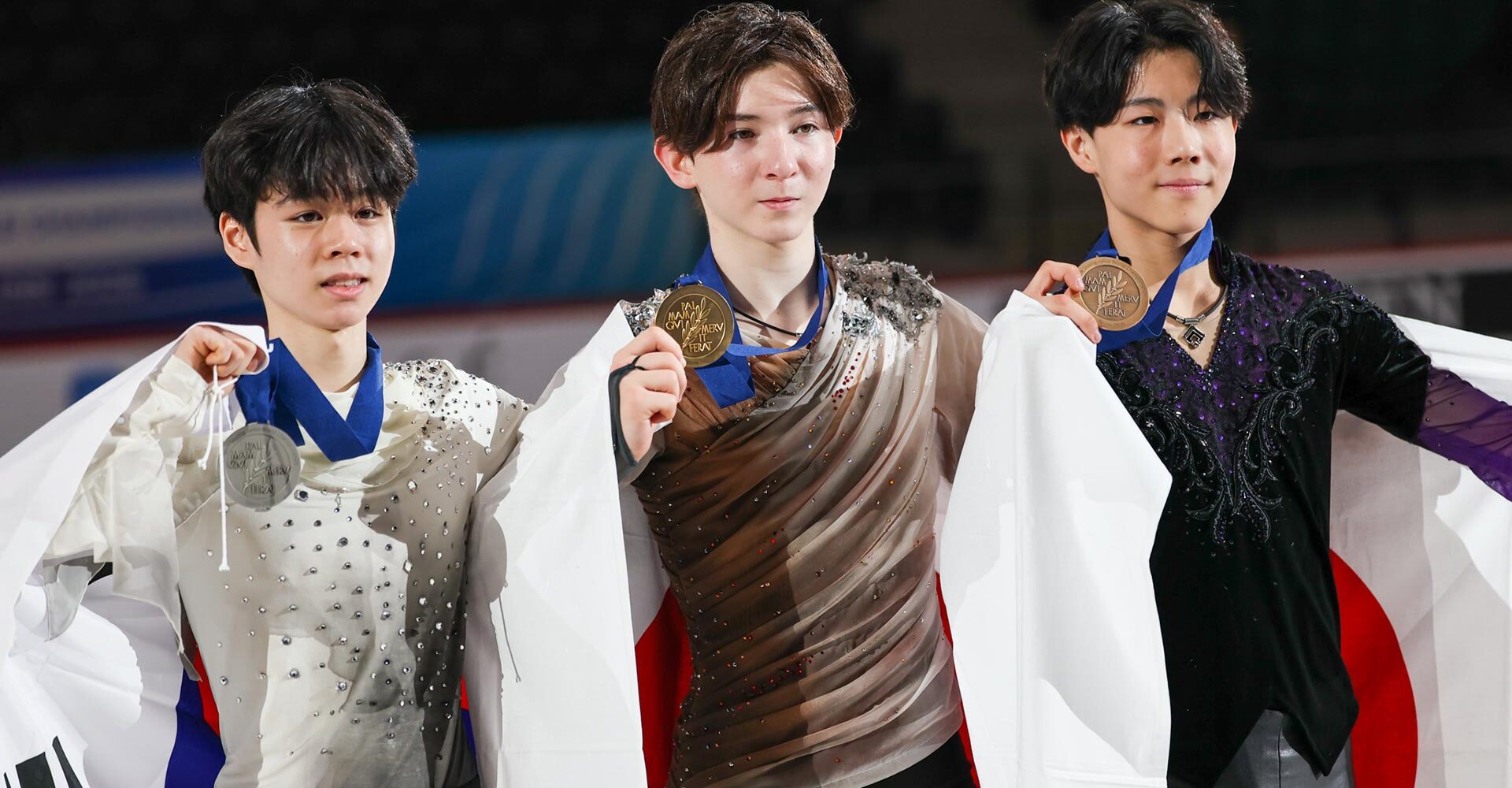
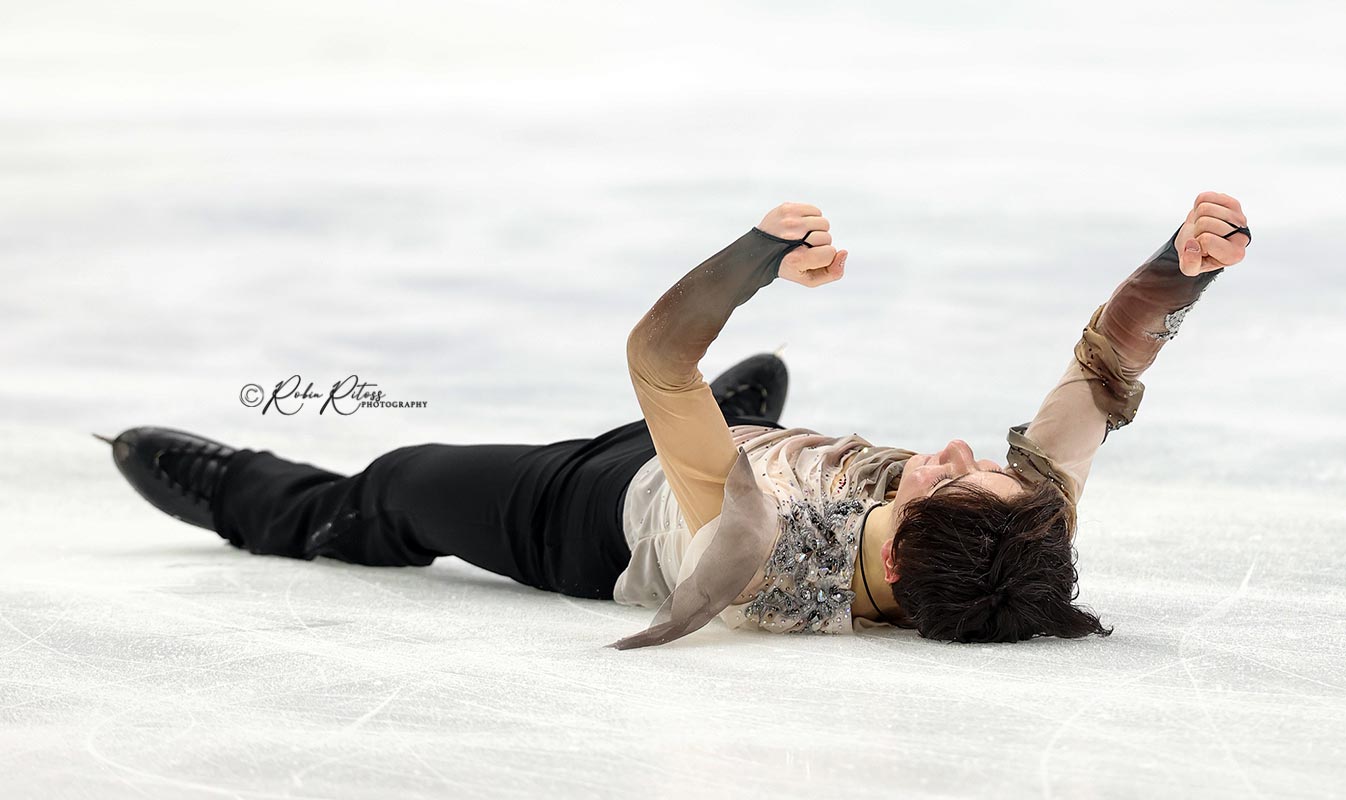 It was once again a battle between Japan’s Rio Nakata and Korea’s Minkyu Seo, both who have won the Junior World title before. However, it was Nakata who was victorious in taking his second consecutive Junior World title. And he did it in record fashion.
The leader after the short program by less than three points, Nakata’s Gladiator free skate included a quadruple Salchow and quadruple toe-triple toe as well as six more triples. He earned a free skate score of 178.96, which was a personal best score. He earned a total score of 268.47, which was also a personal best score and the highest score for junior men. Nakata also earned a personal best in the short program (89.51), which was the highest junior men’s short program score.
“When I landed my first quad I was relieved and I had confidence for my second quad,” Nakata said. “Then there were just triples left, they were easier than quads. I was just happy to skate clean.”
Nakata turned 17 in September and is now eligible to compete on the senior level. He has stated this is his last season on the junior level.
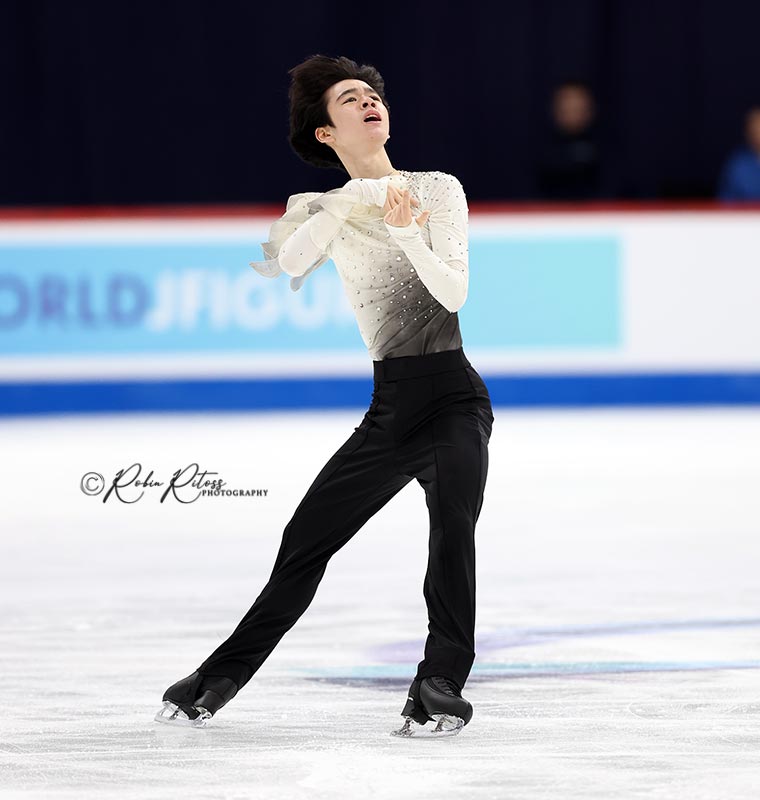
Seo took home his second consecutive Junior World silver medal. In his “Exogenesis Symphony” free skate, he missed his opening quadruple Salchow, but he recovered to produce eight triple jumps. He scored a 157.58 in the free skate, which was third in the segment, but he remained in second place with a total score of 243.91.
“Even though I made a mistake, I went on step by step, focusing on the elements,” Seo said. “Something to improve is the quad as there was a mistake. The spins were good today. Even though it was a difficult situation after the mistake, I tried to do my best in the rest of the program. I am proud of being in second place.”
Seo has two silvers and one gold from the Junior World Championship and will move up to the senior level as well.
Japan’s Taiga Nishino took the bronze medal in his first ISU Junior World Championships.
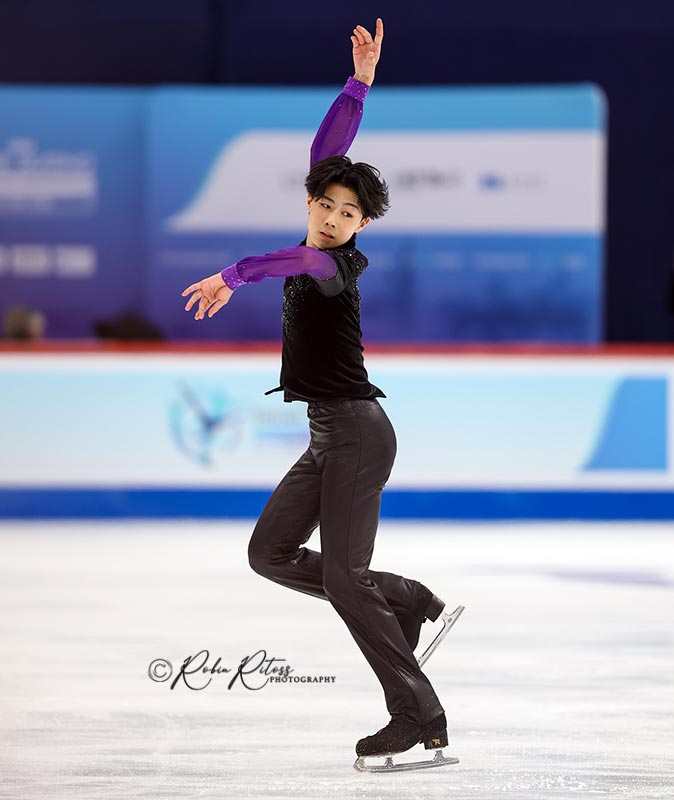 In his “Moonlight Sonata”, “Symphony No. 5” and “For Elise” by Ludwig van Beethoven, Nishino opened with two quadruple jumps – quadruple toe and quadruple Salchow. He earned a new personal best of 160.09 points, which was second in the segment, and he moved up from fourth in the short program to claim the bronze with a total score of 241.23.
“I was pretty nervous but I was able to skate a clean program and I fought until the end,” Nishino said. “I could improve the two quads as they were not as good as I can do them and the triple Axel got a q (slightly under-rotated).”
At only 16 years old, Nishino will remain on the junior circuit next season.
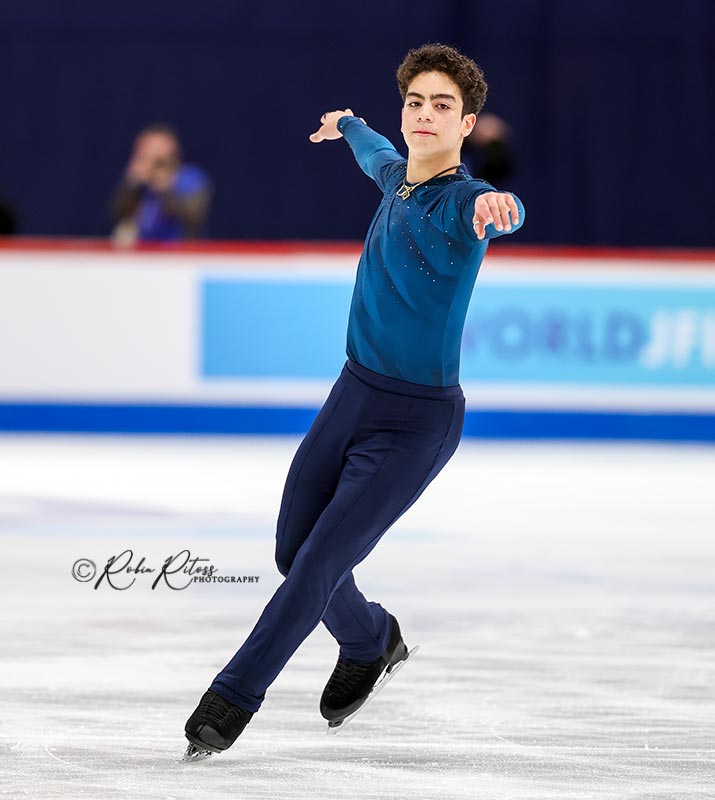
For the second straight year, Team USA’s Jacob Sanchez missed the World podium and finished in fourth place. Though he didn’t have any quadruple jumps, Sanchez executed a triple Axel-triple toe combination and a triple Lutz-double Axel-double Axel sequence. He did double a planned triple loop. He finished fifth in the free skate with a free skate score of 148.07 and finished with a score of 229.10. This was Sanchez’s last junior competition.
“A bittersweet ending to an exciting time of my career. I’m still not sure what to think about this season’s World Juniors as I had very high aspirations and goals to achieve. Coming short from the podium for the second time in a row has been the most difficult part for me,” Sanchez said in a post on Instagram. “I really wanted to be on the podium with the two guys that were my biggest competitors the last three years one last time. Besides any disappointment, I’ve felt an overwhelming sense of pride and accomplishment in my season. This season was incredibly difficult for me as it was for many. I’m most proud of my perseverance and determination throughout the year.”
Though he didn’t medal, Sanchez, along with ISU Junior Grand Prix Final bronze medalist Lucius Kazanecki, who finished sixth, secured three spots for next year’s Junior Worlds for Team USA.
Korea’s Habin Choi pulled up from ninth place to finish fifth with 224.36 points. Japan’s Daiya Ebihara dropped from third after the short program to finish ninth overall.
A total of 43 men competed in the event, with only 24 qualifying for the free skate.
Pairs
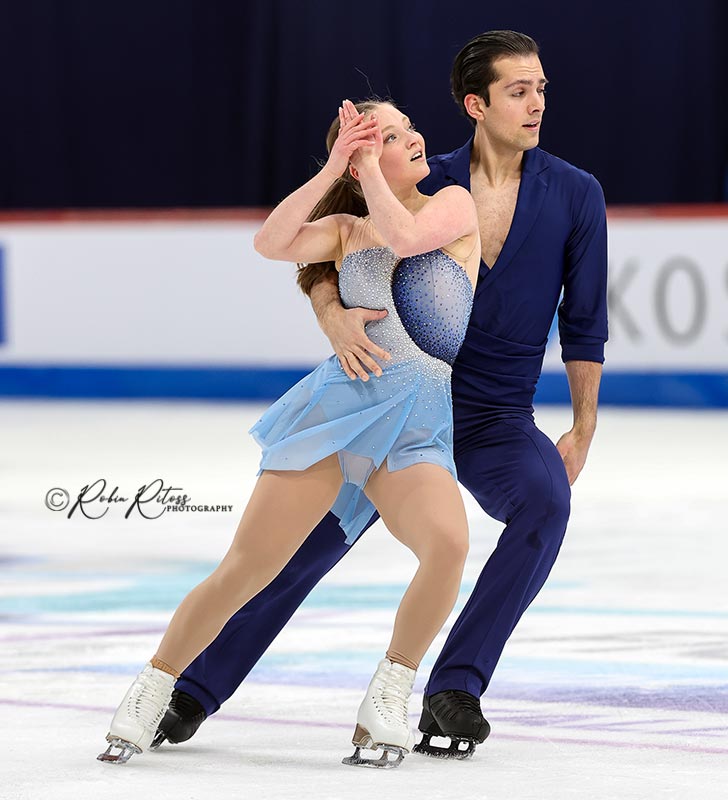 After the short program, less than a point separated teammates Jazmine Desrochers and Kieran Thrasher, and Ava Kemp and Yohnatan Elizarov of Canada. The two teams have competed against one another a few times this season with Kemp and Elizarov finishing ahead of Desrochers and Thrasher at Ice Challenge, the Junior Grand Prix Final and Canadian Nationals. And once again, Kemp and Elizarov jumped ahead of their teammates to claim the gold medal and become the first Canadian pairs team to win Junior Worlds since Barbara Underhill and Paul Martini won their junior world title in 1978.
In their “Clair de Lune” free skate, Kemp and Elizarov completed a triple twist, a side-by-side triple Salchow-single Axel-single Axel sequence and a throw triple Lutz. Kemp fell on the throw triple toe and stepped out of the throw triple loop. They earned a free skate score of 105.68 and a total score of 167.90 to claim the title.
“That means everything to us,” Kemp said about winning that first Junior World title in almost half a century.
This was Kemp and Elizarov first junior world medal. Last season, they finished 10th in their Junior Worlds debut.
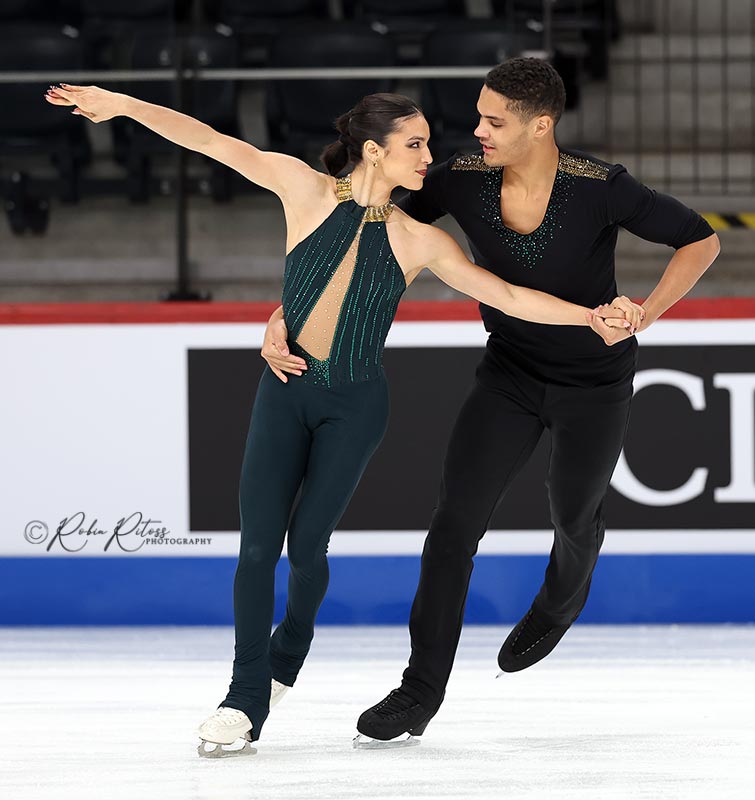
Desrochers and Thrasher claimed the silver medal. In their “Since I’ve Been Loving You” free skate, they made some errors, including Descrochers falling on the throw triple Salchow and stepping out of the throw triple loop. They earned a free skate score of 99.41, which was fourth in the free skate. They dropped from first after the short program to second overall with a score of 162.25.
“At the end of the day, we’re just happy to have been able to be here,” Desrochers said after the free skate. “Putting out that short program was really a big step for us this season, so I think we definitely have stuff to be proud of.
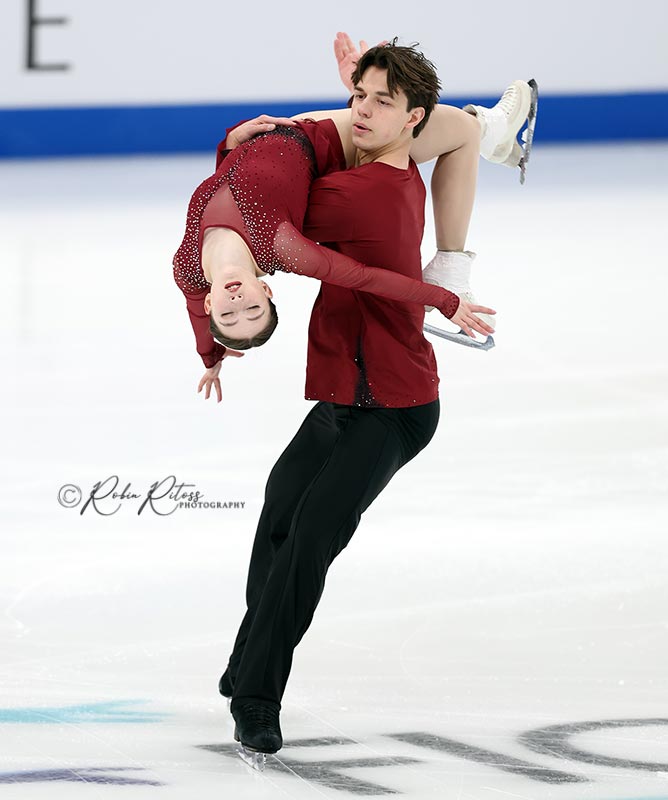 In their first season together, Ukraine’s Hannah Herrera & Ivan Khobta took the bronze medal, moving up from fifth after the short program. In their “Primavera” free skate, they produced a triple twist, side-by-side double Axel-double Axel-single Axel sequence. Herrera did single the side-by-side Salchow. They were second in the free skate with a score of 103.20 and took the bronze medal with a score of 160.15. This is Herrera’s first Junior Worlds and first Junior Worlds medal. This is her first season as a pairs skater. She previously competed singles for the U.S. For Khobta, he previously won the bronze medal three years ago with then-partner, Violetta Sierova.
“As a pair team that skated at their first [Junior] Worlds, not even having a year in the partnership, you just couldn’t expect to have this success,” Khobta said. “I want to say thank you to everyone who supported us.”
“I’m just kind of taking it all in, I guess. I just started [skating Pairs] a year ago,” Herrera said. “I didn’t know if we were going to make it to this point or anything. I’ve just been taking it all in as I go, trying to gain experience. I’m really thankful to my coaches and Vania [Ivan Khobta]. He’s been really helpful in making sure I’m learning everything.”
China’s Yuxuan Chen and Yinbo Dong, who were sixth after the short program, moved up to fourth place. In their Romeo and Juliet free skate, their only mistake was the jumps in their triple flip-double Axel-double Axel sequence were under-rotated. They had the third best free skate with a score of 101.25 and moved up to fourth with a score of 157.99.
The 2024 World junior silver medalists Olivia Flores and Luke Wang, who were in fourth after the short program, had quite a few mistakes in their Crouching Tiger free skate, including a fall on the side-by-side triple toe. They earned a free skate score of 92.03 and finished in fifth overall with a score of 149.99. Reigning Junior Grand Prix Final Champions Rui Guo and Yiwen Zhang of China performed an excellent quadruple twist, but had three falls in their Greatest Showman free skate. They earned a 88.49, which was ninth in the segment. They dropped from third after the short program to place sixth overall with a score of 146.83.
Team USA’s Reagan Moss and Jakub Galbavy improved on their 17th placement at last year’s Junior Worlds, and finished seventh overall.
A total of 18 teams competed in the pairs’ event, with only 16 qualifying for the free skate.
Dance
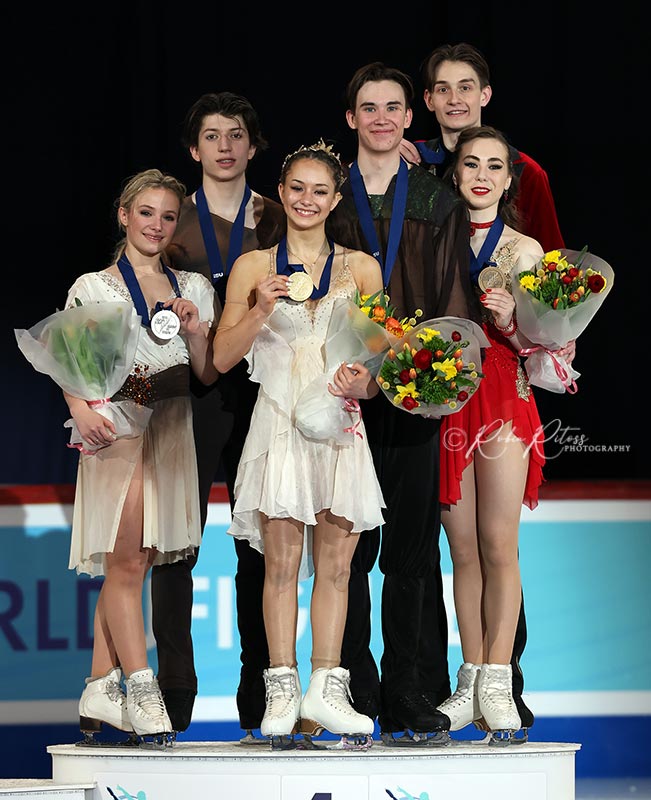 U.S. junior champions Hana Maria Aboian & Daniil Veselukhin took home their first Junior World title, with Ambre Perrier Gianesini & Samuel Blanc Klaperman of France earning the silver medal while Ukraine’s Iryna Pidgaina & Artem Koval claimed the bronze.
For a recap of the dance event, visit Ice-Dance.com.