By Victoria Burdman of Celebrate the Weekend
Photos by Robin Ritoss and Victoria Burdman
In June, the International Skating Union (ISU) announced that it would allow eligible skaters affiliated with its members federations in Russia and Belarus to compete in ISU events and international competitions as neutral athletes (AIN) beginning with the 2026-2027 season. This move ended the nearly four-year ban of Russian and Belarusian skaters in ISU events and international competitions, which was put in place after Russia’s full-scale invasion of Ukraine on February 24, 2022.
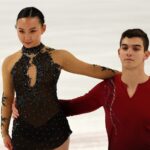
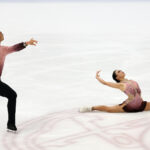
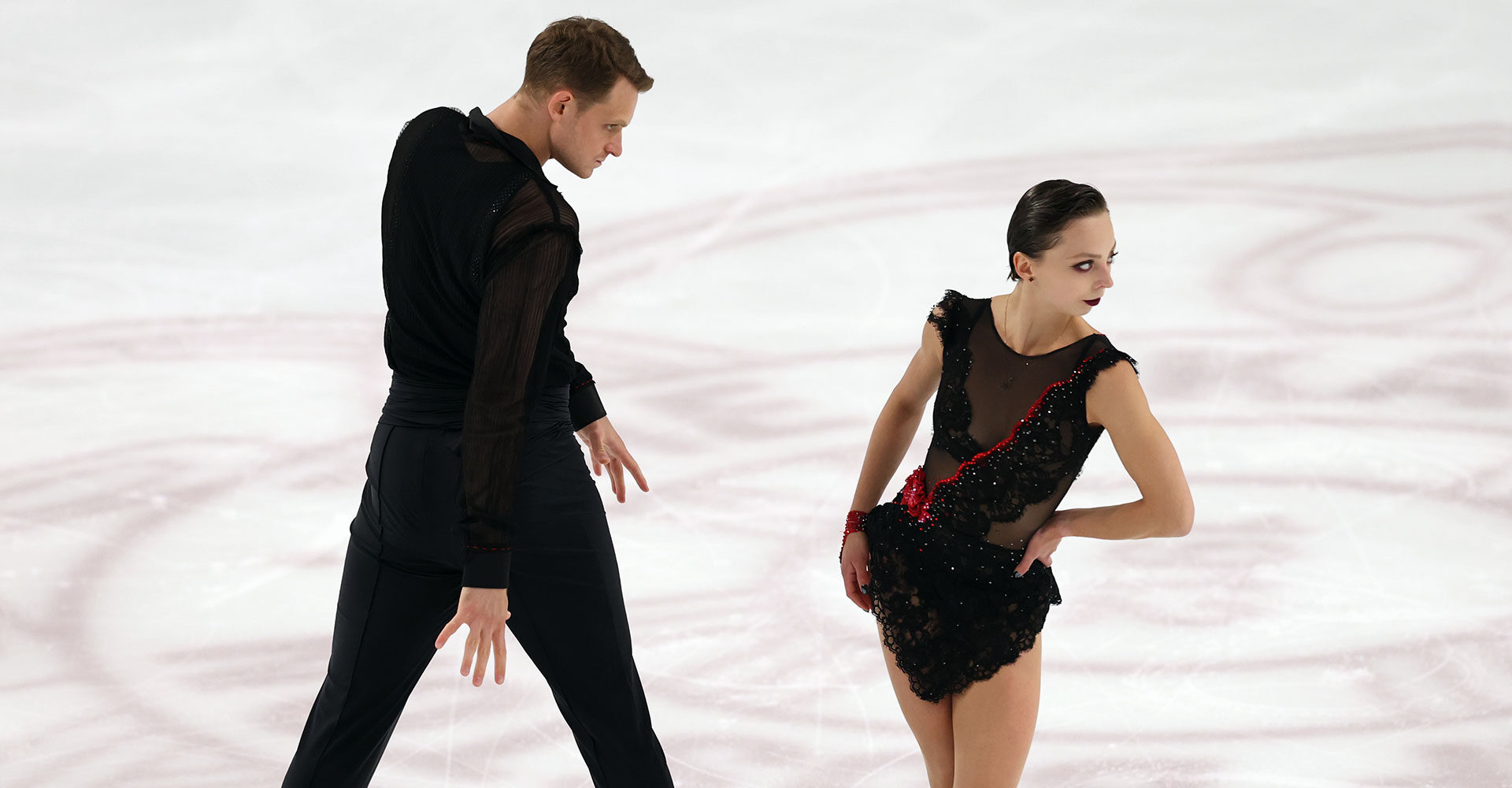
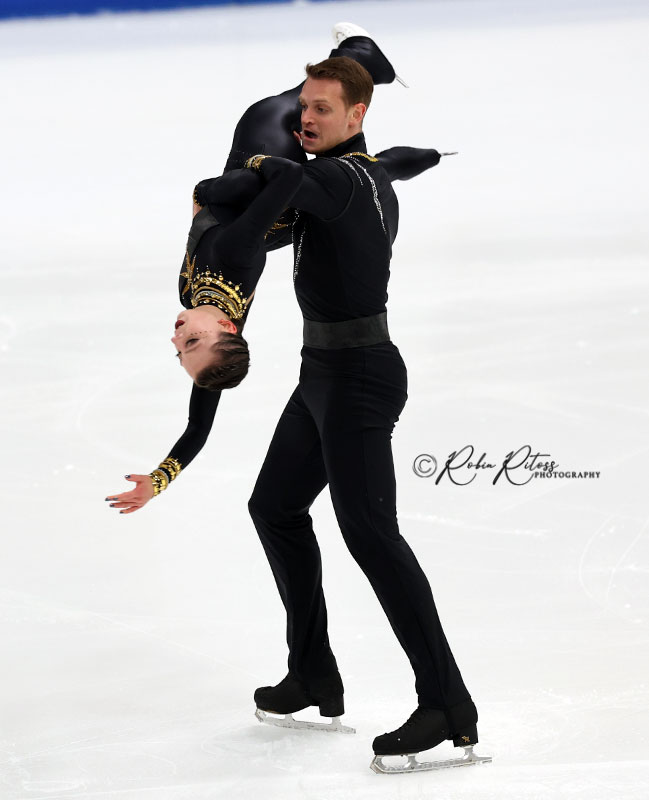
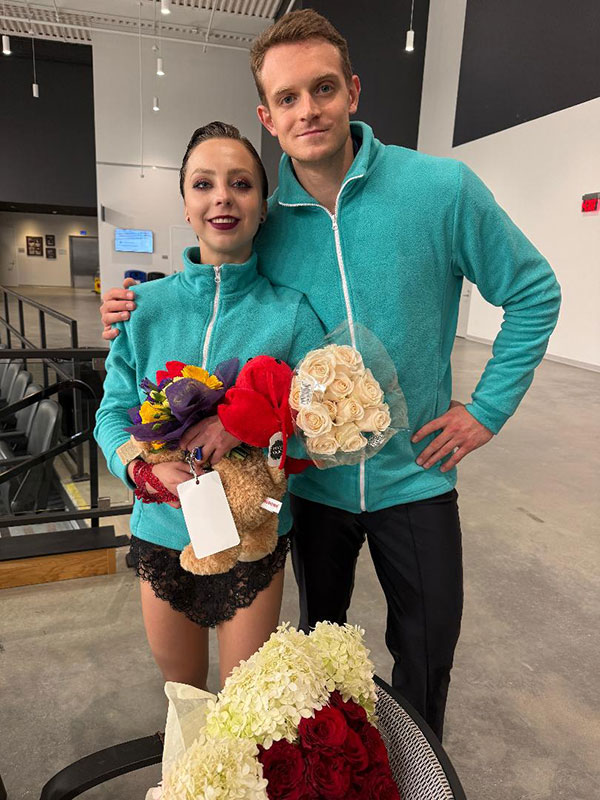
Aleksandra Boikova and Dmitrii Kozlovskii have returned to international competitions as individual neutral athletes. On Sept. 6, they won the ISU’s Kinoshita Group Cup Challenger Series event in Japan and then finished on top of the podium at the John Nicks Pairs Challenge at the Skating Club of Boston. Their Carmen-themed free skate included a quadruple (Salchow) throw and earned them an almost 15-point lead over the new U.S. pair team of Audrey Shin and Spencer Akira Howe, who finished second in the free skate and second overall. Another new U.S. pairs team, Kate McBeath and Balazs Nagy earned bronze. Boikova and Kozlovskii are 2021 World bronze medalists and 2020 European champions.
Correspondent Victoria Burdman of Celebrate the Weekend caught up with Boikova and Kozlovskii at the John Nicks Pairs Challenge. Victoria translated the interview from Russian.
(Editor's Note: On August 28, the Ukrainian Figure Skating Federation sent a letter to the ISU challenging AIN eligibility of several Russian figure skaters. Eight Russian skaters were specifically named in the letter, including Boikova and Kozlovskii. Two of the eight skaters mentioned in the letter have had their neutral athlete status revoked, but as of Sept. 16, Boikova and Kozlovskii are still eligible to compete as individual neutral athletes.)
VB: Please share your emotions after the competition.
Kozlovskii: We feel wonderful. We are very happy to be skating here in the U.S. We feel that the audience is very open, very warm here with great attention and respect to all athletes. We are relieved that our current world traveling competition segment has come to an end. Last week, we competed in Japan. This week, we are competing here in Boston. We won both events and I think we met our “minimum” objective.
Boikova: We are, indeed, very happy with how we handled this competition tour. Of course, we had imperfections in our programs but we received useful feedback from the technical panel, in particular, on what we have to work on going forward. We have, also of course, reviewed the judges’ protocols that highlight what we have to work on as well. What’s most important is that we have a plan of action and we now will try to better our own “prior selves.” So yes, we are happy to have fulfilled our “minimum” objective, having won two times.
VB: What has been the most difficult part of returning to international competitions for you?
Boikova: To take the ice for the short program in Japan. It was a forgotten feeling after not performing for four years internationally. It was very difficult, very nerve-wrecking to come back to international competition with a new program; you want to show the best version of the program at the moment and it does not always work out. Sometimes, this strong desire messes up the performance. We are still happy with how things worked out in general.
VB: Why did you decide to choreograph the short program in Montreal?
Kozlovskii: We really wanted to work with foreign choreographers and it is going without saying that the team in Montreal are the world’s leading ice dance specialists.
[VB: Montreal’s “I. AM” Academy is primarily an ice dance center. Boikova/Kozlovskii’s Black Panther short program was choreographed by Roman Haquenauer, one of the center’s main coaches and choreographers.]
VB: Why did you want to work with an ice dance choreographer?
Kozlovskii: Precisely, because they are an ice dance school. They are focused on choreographing for the ice teams. They understand couple’s skating and how to choreograph comfortable programs. It goes without saying that it is much more difficult to choreograph an ice dance program than an ice pairs program, so we were confident that they would make a great product for us. And I can say now that they did make a great product, we just need to fine-tune it. It is now our job. It’s been a huge challenge. We have finished putting the choreography together only 4-5 weeks ago and it’s been very difficult to start performing it so soon (normally we have about 3 months). So it’s been a challenge.
And regarding our return to international competitions, the most difficult aspect was the travelling through multiple time zones. Last week, we performed in Japan, now we are here in Boston, which is another 13-hour time change. Yes, we did have an experience of doing two competitions in a row in the past, but it was within Russia and not with such a significant time zone change. So here was a unique experience for us and I think we came out on top.
VB: The strategy of doing two back-to-back ISU challengers (and winning them) seems to have been justified- you were just invited to compete at Finlandia Trophy, an ISU Grand Prix series event.
Boikova: We planned to compete at the two early ISU challengers so we could then focus on national competitions (should we not be assigned a Grand Prix event) and to gain international experience (should we be assigned a Grand Prix).
As we can see, we have a lot of work ahead. On the short program, in particular, we need to manage to get a lot of mileage on this program under pressure. In training it has been going rather well, but during the competition, with added stress, we start getting behind the music and rushing. So we will try to eliminate this (smiles) and to bring it to the Grand Prix in a better form.
VB: Speaking of comfort, is there a set of factors that help you feel the most confident at the competition and how does it in turn affect the performance?
Kozlovskii: Let’s start with the simple things. Of course, we like it when there is a good ice quality. The ice quality is really different at different arenas: water temperature, water quality and general arena temperature. Here at the Skating Club of Boston, the ice quality is very good (as is in Japan). I think it’s because the ice is not used for hockey. We prefer “soft” ice, unlike the hockey players who prefer “overly frozen” ice. This is a very important factor for us. Another factor is the audience. When there is an audience, when there is loud support, it adds a boost, the energy to continue performing under pressure. We are professionals and we try not to focus on external factors, but of course, we won’t deny the obvious that these do affect us. Having an audience is the main difference between ordinary training and competition.
VB: It would seem that having an audience might also take a skater out of a comfort zone...
Kozlovskii: In general, in figure skating, the audience is quite respectful. In our sport, it is based on respect, and fans at the figure skating arena are typically a “quality” bunch.
VB: We did have a rather small crowd yesterday during the short program. This event used to be in the Skating Club of New York with not too many audience seats so that could explain the smaller crowd.
Kozlovskii: It was also a work day…
AB: We always hear the audience. If you are skating, you hear the support and it does provide additional energy.
VB: How do you recover during and after the competitions?
AB: We try to nap after the practice and before the start of the competition and… to eat, of course! You need the energy. We need the carbs. Our coach always encourages us to eat something sweet right before competing.
Kozlovskii: Here is a little secret from us: quick carbs for quick energy boosts - not the proteins- right before going on ice to compete. Proteins are great in recovery stage, after the competition. Now we are finished performing and are headed into Boston to look for a good lobster meal. Hopefully we will find it. And of course, taking naps, just lying down- this is what we do to recover.
VB: What did you eat today before the free skate?
Kozlovskii: Pasta
Boikova: Chocolate
VB: Will you have time to take a break from skating when you return home?
Boikova: When we return, we would need to get ready for national test skates in Moscow next week [the weekend of September 19-20]. So it would be a third week of nonstop competing for us and it’s not easy. After the test skates, we will probably take a couple of days off to recover: to rest at home, to walk around some. May be we get some massages. Normally, we have 1- 1.5 day to recover after the competitions. We can’t lose the “form” because we have competitions coming up.
VB: Have you enjoyed visiting Boston? (The pair spent a couple of days here prior to the start of the competition and they also had a free day before their flight back home)
Kozlovskii: We are in awe of Boston. It is a beautiful European-like city in spirit and in form, with Irish flair in some places. We are very impressed. This is our first Boston visit and we are hoping to have a chance to come back.
The pair toured Cambridge and visited Harvard Art Museum on a rainy Sunday after John Nicks competition before their flight back home.